LLMs Won't Take Your Job...
... but you may still lose it.
There is currently much hullabaloo in the software-producing1 domain about whether LLMs (or AGI generally) will soon™ replace us all (or indeed, all white collar jobs).
Personally, I find this smells suspiciously similar to the hype cycles of yore2, but even ignoring that on the basis that LLMs do have extremely widespread applications in this space and acceleration for various workloads3, I firmly believe that we are approaching the upper asymptote of LLMs' capability space.
Most recent advances are in the tooling around running the model or providing general-purpose computing capabilities to them (read: finding ways to throw ungodly amounts of tokens into the money machine); the models themselves have stagnated4.
However, for the sake of the argument, let's assume that models are either already good enough to replace developers5, or will be in the near future.
They still won't take your job.
This is because fundamentally, our jobs as software engineers are not to produce code, but to bridge the gap between the business and the real world (also because producing code was never the bottleneck, and this will only enable the production of more code, not reduce the number of people doing so).
A manager does not want to tell an LLM what they want, they do not need a sycophant who will blindly say "yes boss" to the wrong requests, and a manager cannot fire a poorly performing LLM.
This is, of course, not to say that our jobs are safe.
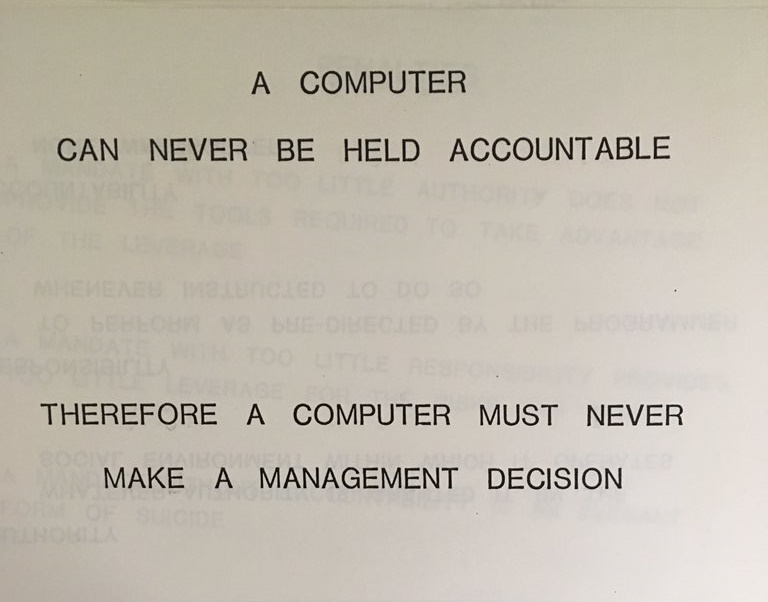
A manager also does not want to be held responsible, and bless your cotton socks if you think that executives will be either, so the buck will always be passed down as far as possible6. We are always required to be the fall guy, if nothing else.
Service fails and production goes down? Jail Fired. Not enough LLM-produced code? Fired. Too much LLM-produced code? Believe it or not, fired. No trial, no nothing, if you didn't use enough tokens this sprint, fired.
We won't be replaced... but we will still be displaced.
-
I include in this software engineering, computer science, and whatever it is that you consider vibe coders (or they consider themselves) to be.
Unfortunately, despite having very different requirements and reward systems, there is a lot of overlap between these disciplines and discourse becomes difficult to separate because of it. ↩ -
What do no-code solutions, NoSQL, and offshoring all have in common? They were promised to be the end of SE roles in the west7 within my career, but... did not. ↩
-
The models are trained on the open-source corpus — so naturally it's going to be better at building yet-another-React-app (which it has incorporated thousands of) than it is at dealing with very domain-specific knowledge, or lesser-used frameworks or languages. Know its strengths and use them. ↩
-
The general consensus is that they've only really just Gotten Good in the last six months, but my opinion is that that was just the exponential section of the S-curve eventuating, and it's all minor returns from here on.
This post may or may not age poorly. ↩ -
If this is true of your role, then good luck — it was probably already under threat by the hordes of boot-campers attracted by the promise of massive pay-cheques on 10-hour-a-week gigs. ↩
-
This does differ depending on company size and culture (which are intrinsically linked), and certain configurations may insulate you more or less from this. ↩
-
This is of course, a misnomer, but I understand the usefulness of having a term to mean 'fat-laden established economic powers waiting to have their lunch eaten' ↩